
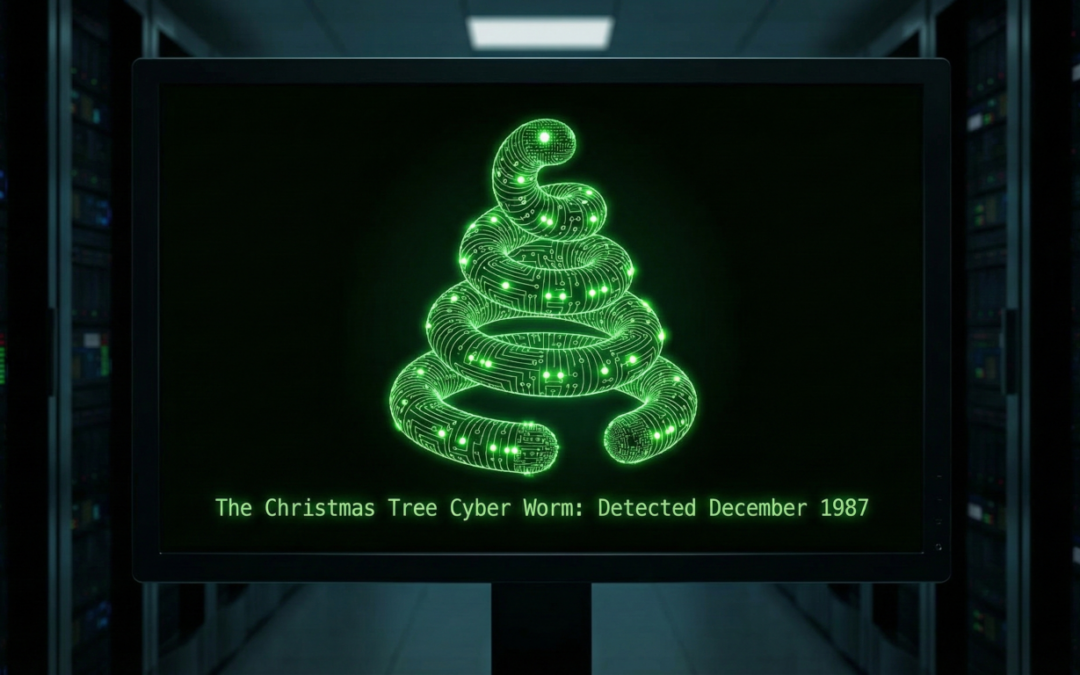
In December 1987, as office workers were winding down for the holidays, a seemingly innocent digital greeting card began appearing on IBM mainframe terminals. It was titled CHRISTMA EXEC, and its arrival marked one of the first times the world witnessed the true power—and danger—of self-replicating code.
What began as a festive surprise quickly turned into a digital blizzard that paralyzed global networks.
A Festive Facade: The ASCII Surprise
When a user ran the CHRISTMA EXEC script, their terminal displayed a charming, flickering Christmas tree made of ASCII characters. It was a delightful bit of holiday cheer for an era when digital graphics were still in their infancy.
However, while the user was admiring the tree, the script was busy behind the scenes. It wasn’t just a drawing; it was a worm.
How the “Christmas Tree” Spread
The CHRISTMA EXEC was a masterclass in early social engineering. It leveraged digital trust long before “phishing” was a household term. Here is how it worked:
- Self-Replication: Once executed, the script scanned the user’s electronic address book.
- Automatic Propagation: It automatically sent a copy of itself to every contact it found.
- Network Saturation: Because it targeted IBM’s VNET, a massive interconnected system used by corporate, academic, and government entities, the spread was exponential.
Within hours, the sheer volume of duplicate emails overwhelmed mail servers. Network speeds slowed to a crawl, and in many cases, entire systems were forced offline to purge the “festive” flood.
Not Malicious, but Destructive
Interestingly, the creator of the worm—a student at Clausthal University of Technology in West Germany—did not design it to steal data or destroy files. It was intended to be a harmless prank.
However, the incident taught the tech world a vital lesson: Intent does not equal impact. Even “fun” code can become a significant threat when combined with automation and high connectivity.
Why the 1987 Worm Still Matters Today
The Christmas Tree Exec incident was a pivotal moment in the history of cybersecurity. It forced organizations to realize that the “nascent” digital world was inherently vulnerable. The event highlighted three major pillars of modern security:
- The Danger of Social Engineering: People are often the weakest link in the security chain, especially when a threat is disguised as something familiar or friendly.
- The Need for Email Safeguards: This incident sparked the early development of filters and execution restrictions for email attachments.
- The Risks of Interconnectivity: As networks grew larger, the speed at which a single “bad actor” (or even a bad script) could impact the entire system became a primary concern.
A Legacy of Awareness
Today, we look back at the 1987 ASCII tree as a “proto-virus” that paved the way for modern antivirus software and network protocols. It remains a stark reminder that in the world of cybersecurity, even the most innocent-looking greeting can hide a digital storm.
This article was researched and written by our team, with AI assistance used solely for copy-editing and rephrasing to improve readability.

To see our team in action, please join us for our weekly webinar every Tuesday.